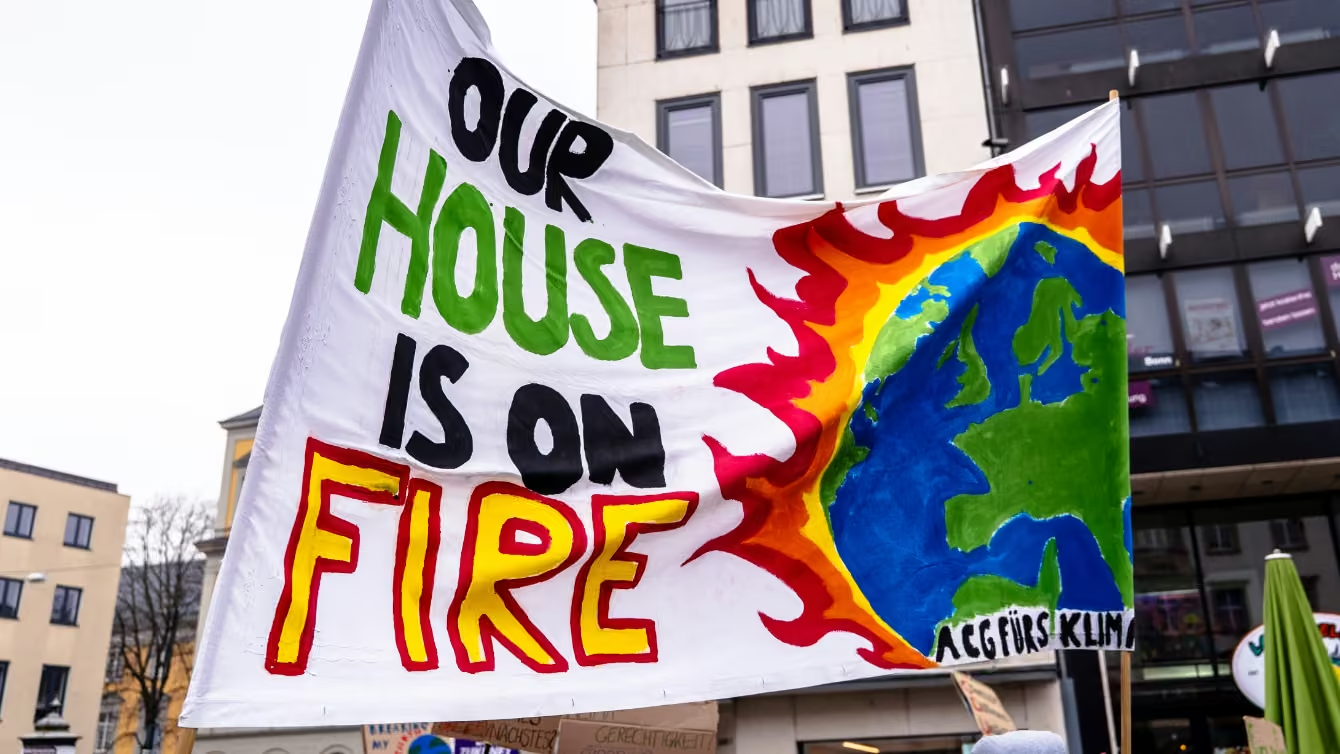
As a severe heatwave sweeps across Europe – with temperatures reaching a record 43.3°C in France and hundreds of people across the continent having died already – the urgency of climate action is visceral. This heat dome is not a summer anomaly; it is a harbinger.
Europe, heating up at twice the global average, is experiencing heatwaves earlier and more intense than ever before.
Solutions exist, and they’re emerging from university labs. Here are four spinouts that are building climate tech solutions to make sure there is a world for us to live in.
Active Surfaces brings peel-and-stick solar panels to rooftops
Active Surfaces has engineered ultra-light, flexible perovskite solar modules that literally peel-and-stick onto roofs, walls, and surfaces where rigid glass panels can’t be installed.
The product, based on a decade of MIT research, cuts installation costs by up to 10x, and deployment becomes instant.
The spinout’s innovation extends to encapsulation technology to protect against degradation caused by oxygen and moisture, and coating control to ensure uniformity in film quality.
Active Surfaces has achieved a power conversion efficiency of just over 25.2%, matching regular solar panels. They last more than 10 years, which is less than traditional panels, but cheaper, faster deployment beats longevity every time in a climate emergency.
Founded in 2022, Active Surfaces raised a $5.6 million preseed round in May 2024 led by Safar Partners, and a consortium of more than half a dozen VCs. Japanese utility J-Power put in an undisclosed sum last October.
Ureaka tackles cement’s massive CO2 problem
Ureaka, spun out from the University of Strathclyde, is turning demolished concrete into cement replacement using circular chemistry.
The process recovers silica and calcium from waste, locks captured carbon into stable carbonate minerals, and arrives as a powder that drops directly into existing cement mixtures. In other words, current concrete manufacturing processes don’t need to be adapted.
Why does this matter? Cement, and in turn concrete, are responsible for approximately 8% of global carbon emissions. If that doesn’t sound like much, consider that aviation, often called out for its negative impact, contributes only 2.5%.
Ureaka has received proof-of-concept funding from the Industrial Biotechnology Innovation Centre Spin Out Fund and is now seeking seed investment and additional grant funding.
Qurie brings a fresh approach to refrigeration
Qurie, spun out of the Fraunhofer Institute for Physical Measurement Techniques earlier this year, replaces compressors and refrigerants with electrocaloric ceramics and polymers that cool via an electric field.
There are no hydrofluorocarbons, meaning the EU’s F-Gas Regulation is handing Qurie a massive market.
The spinout is young, but the tech is battle-tested through a decade at Fraunhofer. At commercial scale, the technology promises 40% energy savings, and because it’s a solid-state design, it can be deployed in medtech, EVs, and consumer electronics.
TT49, High-Tech Gründerfonds, and Aepikur have injected €2.2 million.
Kvasir cooks up carbon-neutral biofuel from agricultural waste
Kvasir Technologies cooks agricultural and forestry waste – non-edible lignin residues – in pressurised alcohol to make carbon-neutral biofuel.
The TU Denmark spinout’s one-step process produces a direct fossil fuel replacement, initially aimed at marine shipping, with possible applications in aviation and the biochemicals industry.
Maersk Growth, the corporate venturing arm of shipping and logistics giant A.P. Moller-Maersk, backed a €10 million series A round for Kvasir last week, together with the Export and Investment Fund of Denmark, Footprint Fund, and European Energy.
The spinout is currently capable of producing up to two tonnes of biofuel per day, and will use the series A cash to build a commercial plant in Aabenraa in southern Denmark.